
How to Choose Data Security Standards for Compliance Platforms
Quick Summary
Data security standards for compliance platforms are the documented controls, policies and evidence requirements that define how a platform protects the data it stores, processes and reports on. Choose them by starting with a data inventory, then filtering for legal, contractual and market applicability.
- Build the applicable-standards list from a data inventory covering category, location, access and lifecycle.
- Apply three filters: legal applicability, contractual applicability and market applicability.
- Tier standards into Tier 1 mandatory, Tier 2 contractual and Tier 3 market-differentiating.
- Map every framework onto one internal control catalog to collect evidence once per control.
- Verify the vendor's own SOC 2 Type II report and ISO 27001 scope statement before buying.
Table of Contents
- What Data Security Standards Mean for a Compliance Platform
- Why Compliance Gaps Cost More Than Compliance
- Compliance Standards Examples You Are Likely to Encounter
- Compliance Standards List: How to Decide What Applies
- Mapping One Control Set to Multiple Standards with NIST Security Controls
- Evidence Collection, Continuous Compliance, and Data Lifecycle Controls
- Evaluating Compliance Management Software and Its Own Security
- Building a Data Security Standards Roadmap for Your Platform
- Frequently Asked Questions
What Data Security Standards Mean for a Compliance Platform
Last Updated: November 10, 2026
Data security standards for compliance platforms are the documented controls, policies and evidence requirements that define how a platform protects the data it stores, processes and reports on. For most U.S. organizations, these standards come from overlapping sources: federal and state law, sector rules and customer-assurance frameworks. Across U.S. organizations, the same problem recurs: each requirement arrives as a separate project with its own spreadsheet, owner and audit cycle.
Here is the core tension. A compliance platform holds the evidence that proves other systems are secure, which makes the platform itself a high-value target. Its own security posture is therefore part of the compliance question, not a separate one.
The NIST Cybersecurity Framework overview gives a useful vocabulary for this work, organizing security into identify, protect, detect, respond and recover functions. Use that structure as a shared language across security, privacy and audit teams rather than a checklist to complete once.
Why Compliance Gaps Cost More Than Compliance
Noncompliance with data security regulations can cost organizations substantially more than maintaining compliance. That gap is the practical case for treating standards selection as an investment rather than an overhead line item. Fines are only part of it. Failed audits delay customer contracts, and rework from duplicate assessments consumes the same staff hours that should go to remediation.
Fifty-three percent of compliance professionals consider managing data privacy a primary challenge, based on a Zluri industry survey of compliance and risk professionals. The same survey found that 52% of risk professionals rank IT and security compliance as a top priority. Those two figures together suggest the bottleneck is coordination, not awareness.
Gaps also compound. A control that fails for one framework often fails for several, because the underlying evidence is missing. Fixing it once, in a shared control catalog, closes multiple findings at the same time.
Compliance Standards Examples You Are Likely to Encounter
Most mid-market and enterprise teams meet a recurring set of standards. The examples below are the ones that appear most often in customer questionnaires and audit requests, and the ones that most often overlap.
SOC 2, ISO 27001, and HIPAA
SOC 2 is an attestation report built on the AICPA Trust Services Criteria, and customers commonly request it from SaaS vendors. ISO 27001 is a certifiable information security management system standard. HIPAA sets federal requirements for protected health information, including administrative, physical and technical safeguards.
These three share a large body of controls: access management, change management, logging and incident response. Teams that document each one separately end up collecting the same screenshots three times.
GDPR, CCPA/CPRA, and PCI DSS
GDPR governs personal data of individuals in the European Union, which matters for U.S. companies serving EU customers. The California Consumer Privacy Act, as amended by the CPRA, applies to qualifying businesses handling California residents' data. PCI DSS applies to any organization that stores, processes or transmits payment card data, regardless of its industry (PCI Security Standards Council).
Privacy obligations like these often require data inventories and deletion workflows that security teams do not own by default. That is where a compliance platform earns its keep, by bringing privacy mapping into the same control foundation.
Compliance Standards List: How to Decide What Applies
The harder and more useful question is which standards actually apply to a given platform, industry, and data type, and which ones you can defer without creating risk. Treat standards selection as a decision framework, not a familiarity test.
Start with a data inventory that records four attributes for every data element: category (personal, health, payment card, government, or confidential business), location (which system, region, and subprocessor), access (who and what can read it), and lifecycle (how long it is kept and how it is deleted). Each attribute narrows the applicable set. Payment card data points to PCI DSS. Protected health information handled by or for a covered entity points to HIPAA. Personal data of California residents above the statutory thresholds points to CCPA/CPRA.
Then apply three filters in order. First, legal applicability: is the standard mandatory for your entity, your data, or your role as a processor or business associate? Second, contractual applicability: do customer agreements, security questionnaires, or vendor terms require a specific attestation such as SOC 2 Type II or ISO 27001 certification? Third, market applicability: does a customer segment you are actively pursuing require a standard you do not yet hold?
A common pattern is to over-scope early. Teams adopt every framework a prospect mentions, then drown in duplicate evidence requests.
Watch out: scope decisions are not permanent. A new customer segment, a new data type, or a contract clause can pull a Tier 3 standard into Tier 1 quickly, so review the scoping decision at least annually and whenever you add a significant data source or subprocessor.
Document the output as a standards register with one row per standard, the filter that qualified it, the data types it covers, the internal owner, and the next review date.
Mapping One Control Set to Multiple Standards with NIST Security Controls
The most efficient approach is to define one internal control catalog and map each external standard onto it. NIST Special Publication 800-53 provides a detailed control library that many teams use as that foundation, because its controls are granular enough to map to most other frameworks.
Start with a gap analysis: for each applicable standard, identify which of your catalog controls satisfy its requirements and which are missing. Document the mapping, then collect evidence once per control rather than once per framework. Assigning one owner per control, not per framework, helps accountability follow the control.
Watch out: mappings are not equivalences. A control can satisfy part of a requirement while leaving a gap, so review each mapping against the exact wording of the standard.
Evidence Collection, Continuous Compliance, and Data Lifecycle Controls
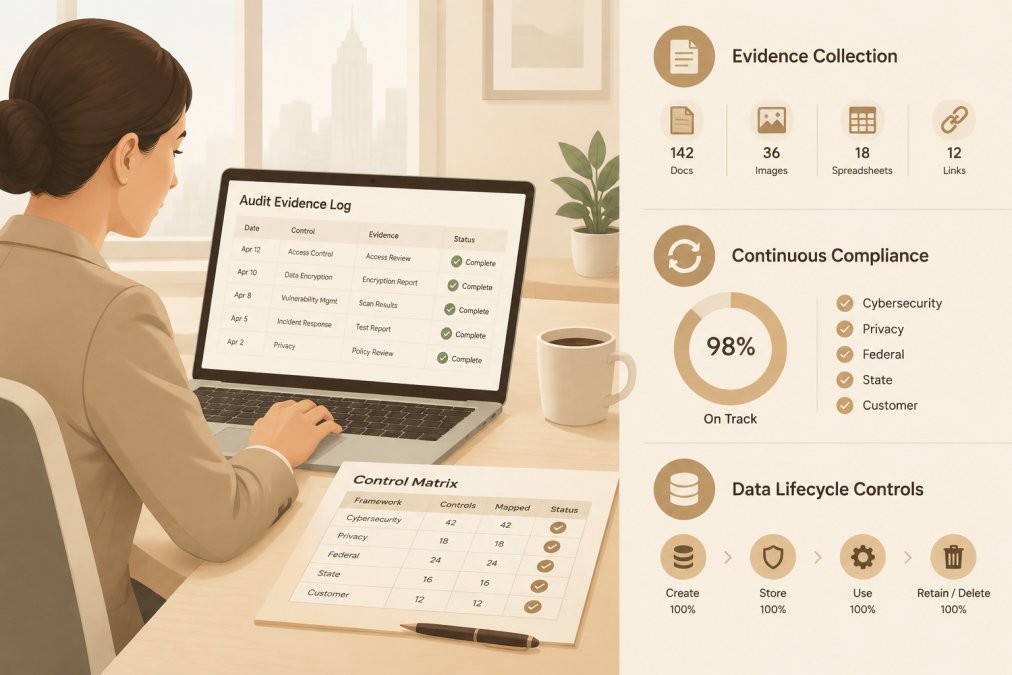
Point-in-time audits show what was true on the day of testing. Continuous compliance shows what is true all year. Automating evidence collection, such as access reviews, configuration snapshots and training records, reduces the scramble before each audit and surfaces drift early.
Data lifecycle controls deserve equal attention. Retention schedules, secure deletion and data residency rules are frequently absent from security programs, yet regulators and customers ask about them directly. Define how long each data type is kept, how deletion is verified, and where the evidence of deletion is stored.
Evaluating Compliance Management Software and Its Own Security
A compliance platform holds your control evidence, risk register, policy library, and often customer data, which makes it a high-value target and part of the compliance question itself.
Request the vendor's own attestations first: a current SOC 2 Type II report with the period covered and any exceptions noted, and an ISO 27001 certificate with its scope statement. Read the scope statement carefully, because a certificate that excludes the production environment or a key subprocessor does not cover what you are buying. Ask for the most recent penetration test summary and the remediation status of high-severity findings.
Then examine the control areas that matter most for evidence and customer data.
Pricing deserves the same scrutiny. Pricing for compliance management software varies with factors such as the number of frameworks, users, integrations, and environments.
Integration depth matters as much as feature lists. Confirm which of your existing tools connect directly, which require manual data entry, and which require a paid connector.
Watch out: a vendor's own SOC 2 report is not a substitute for your review. Read the exceptions, the complementary user entity controls, and the period covered, because a report with a clean opinion but a narrow scope can still leave your data outside the tested boundary.
Keep the evaluation evidence in a vendor due-diligence file with the date each artifact was received and the next review date. That file supports your own audit evidence and gives you a defensible record if the vendor's posture changes.
The evaluation hinges on a handful of checks that a vendor should be able to answer clearly, summarised below.
| Control area | What to confirm | Watch for |
|---|---|---|
| Vendor attestation | Current SOC 2 Type II report and period covered | Exceptions and narrow scope |
| ISO 27001 scope | Certificate scope statement | Excluded production environment or subprocessor |
| Encryption | TLS in transit and encryption at rest | Undocumented or unrotated keys |
| Access control | Role-based access, MFA, admin logging | Broad standing administrator rights |
| Data residency | Storage and processing regions | Unclear cross-border transfer handling |
| Subprocessors | Current list and change notification | Missing flow-down security obligations |
| Retention and deletion | Schedules by data type and deletion verification | Unclear backup handling and exit portability |
| Pricing | Itemised written quote by dimension | Headline price that omits frameworks or environments |
Building a Data Security Standards Roadmap for Your Platform
Turn the decisions above into a sequenced plan. In the first phase, complete the data inventory and the applicable-standards list. In the second, build the shared control catalog and the gap analysis. In the third, automate evidence collection for the highest-priority controls and set a review cadence.
Assign an owner and a target date to each control gap, and track progress in a single report that executives can read without a translator. Measurable outcomes work best: percentage of controls with current evidence, number of open high-severity gaps, and days to close a finding.
When your team is ready to scope this work against your own requirements, you can request a demo of NorthStar Intelligence Portal to see how the platform connects requirements, controls, evidence and reporting.
Best for: CISOs and compliance leaders managing several overlapping frameworks on one team.
Skip if: You only need a single, one-time audit with no ongoing framework obligations.
Frequently Asked Questions
Is NIST 800-53 a standard?
NIST Special Publication 800-53 is a catalog of security and privacy controls published by the National Institute of Standards and Technology. It is a control catalog rather than a certifiable standard on its own, but many U.S. federal agencies and contractors require it. Compliance platforms often use it as a shared control library, mapping each control to requirements from SOC 2, ISO 27001, state privacy laws, and customer questionnaires so one control can satisfy several obligations without duplicate assessments.
Is there a GDPR equivalent in the US?
No single U.S. federal law matches GDPR. Privacy obligations come from a patchwork of sources, including the California Consumer Privacy Act as amended by the CPRA, other state privacy laws, sector rules such as HIPAA for healthcare data, and FTC enforcement against unfair or deceptive practices. A compliance platform needs to track which of these apply to your organization and data types, then map the shared security controls beneath them.
What are the 12 PCI DSS requirements?
PCI DSS v4.0 is organized into 12 requirements grouped under six control objectives: build and maintain a secure network, protect account data, maintain a vulnerability management program, implement strong access control measures, regularly monitor and test networks, and maintain an information security policy. Organizations that store, process, or transmit payment card data must meet these requirements. A compliance platform should map each requirement to the controls and evidence it already collects for other frameworks.
What is the difference between a compliance framework and a security standard?
A security standard, such as ISO 27001 or NIST SP 800-53, defines specific controls or management practices. A compliance framework or regulation, such as HIPAA or PCI DSS, sets the obligations an organization must meet, often by referencing those standards. Auditors may assess an organization against a framework using evidence gathered from its controls. Understanding this difference helps teams decide which controls to implement once and which external requirements they need to demonstrate.
