
Know What You Need. Know Where You Stand. Know What to Do Next.
Most organizations already have the pieces. Policies. Controls. Systems. Risk registers. Frameworks. Evidence. People responsible for security. The problem is that those pieces often live in different places and are managed as separate activities. NorthStar brings them together.
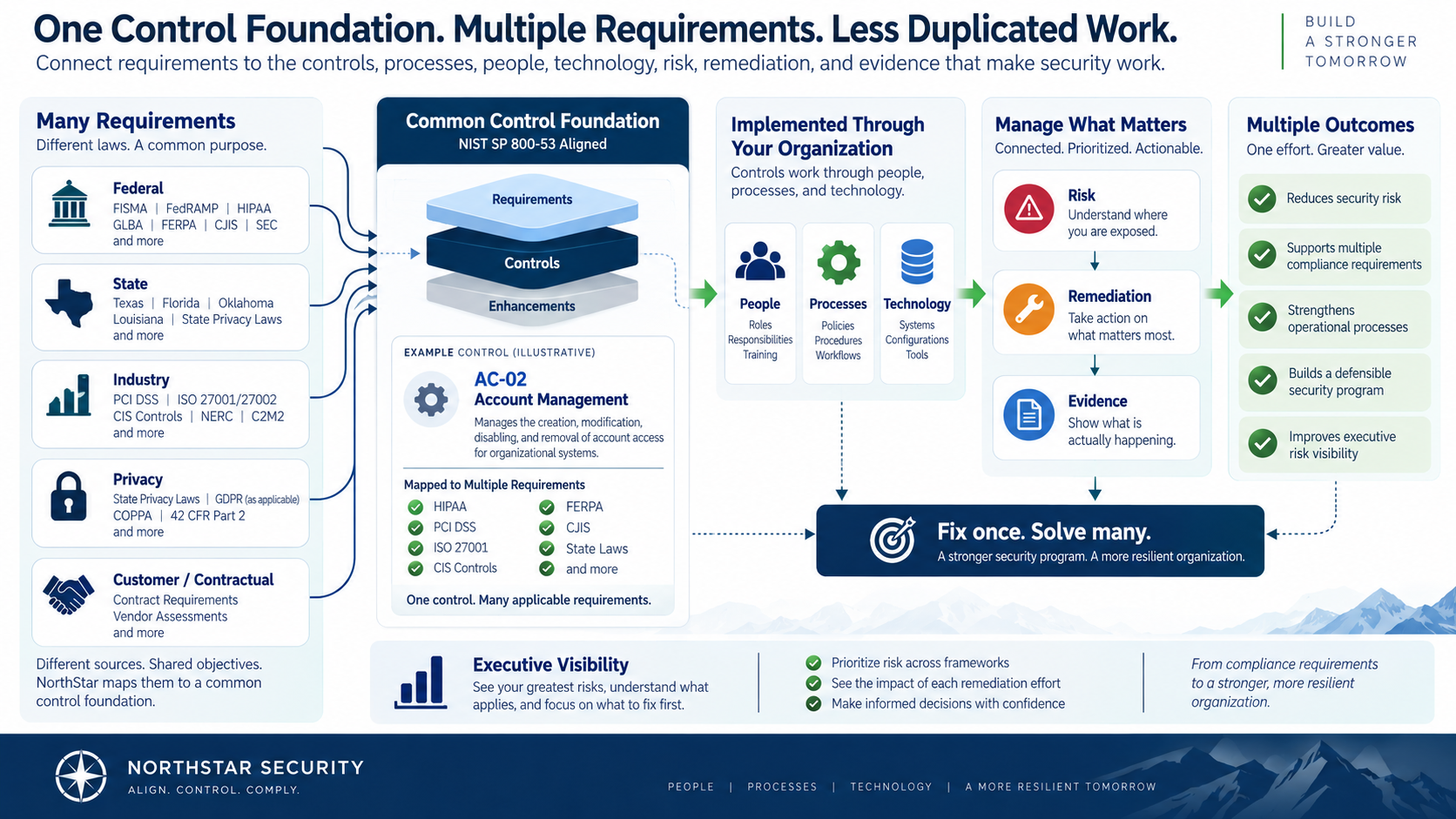
One control foundation. Every applicable requirement.
The NorthStar operating model
NorthStar connects those pieces so a security requirement is not just a line in a framework or a control on a spreadsheet — it becomes part of the way the organization operates.
That is the difference between managing compliance and running a security program.
Technology should support the way the organization operates.
Organizations should not have to reshape the way they do business to fit their technology. Technology should support the way the organization chooses to operate.
That means security controls, governance, risk management, and technology decisions need to make sense in the context of the people and business processes they support.
Business processes
Define how the organization creates and delivers value.
People
Execute those processes.
Technology
Supports those processes.
Security
Protects them.
Governance
Guides them.
Risk management
Helps the organization make informed decisions about them.
That is the difference between managing compliance and running a security program.
1,892
NIST Controls Mapped
200+
Compliance Frameworks
1000+
State Statutes Covered
Real-Time
Risk & Posture Scoring
Privacy coverage built in
50+ international privacy frameworks. One control foundation.
NorthStar maps GDPR, CCPA, CPRA, VCDPA, and dozens of US federal and state privacy statutes — alongside global frameworks like PIPEDA, LGPD, and APPI — directly to the same NIST SP 800-53 control library your security program already runs on.
No separate privacy tool. No duplicate assessments. When a control is satisfied for security, it's satisfied for privacy too.
Privacy is built in — not bolted on.
Most organizations already have the pieces. The problem is that those pieces don't always connect.
NorthStar helps bring those pieces together.
Built for the people who own security and compliance work
CISOs & Security Leaders
See your security posture clearly, prioritize what matters, and hold the program accountable — without rebuilding your reporting from scratch every quarter.
Compliance & Governance Teams
Manage every applicable framework from one control foundation instead of running a separate project for each one.
IT & Technology Leaders
Understand which security requirements apply to your systems and what your team is responsible for implementing.
Executive Leadership
Get a clear picture of organizational risk and program progress — in plain language, not framework jargon.
Why NorthStar Exists
An AI assistant that works with your organization's own data.
The NorthStar AI Advisor works against your controls, risks, evidence, policies, and requirements — not generic internet content. It helps your team do the work. It does not replace judgment or accountability.
Analyze
Find relationships between requirements, controls, risks, and evidence in your organization's specific context.
Interpret
Translate regulatory and control language into plain terms your team can act on.
Identify
Surface gaps, missing evidence, conflicts, and areas where risk is accumulating.
Assist
Help draft policies, remediation plans, and supporting documentation — with your team reviewing and owning the output.
Explain
Show the source and reasoning behind every response so your team understands why something matters, not just what to do.
The NorthStar AI Advisor supports your team's work. It does not make compliance determinations or substitute for professional judgment.
Every element in your program is connected.
NorthStar makes those connections visible — so your team always knows what applies, where things stand, and what to work on next.
Requirement
A regulation, framework, contract, or customer obligation your organization must address.
Control
The security practice that satisfies the requirement.
Implementation
How your organization has actually applied the control in its environment.
Evidence
The documentation that shows the control is in place and working.
Risk
The residual risk when a control is missing, partial, or not working as intended.
Remediation
The plan to close the gap, assign ownership, and track it to completion.
Reporting
The defensible output your leadership, auditors, and regulators can rely on.
How it works
From requirements to a security program you can actually run
Onboard Your Organization
Answer a short set of questions about your industry, size, data types, and regulatory footprint. NorthStar scopes a NIST-aligned control set and identifies the frameworks that apply to you.
Your control baseline and applicable frameworks are in place in minutes, not weeks.
See Where You Stand
Your dashboard shows a live compliance heat map, NIST CSF function scores, open risks, and ownership assignments. Every team member can see what they own and what needs attention.
Example: NIST CSF Protect function at 64% — 12 controls unimplemented, 3 risks open.
Build a Defensible Record
Attach evidence to controls, generate reports, and produce AI-assisted security policies. When an auditor, customer, or regulator asks, everything is organized and ready to export.
From requirements to a security program you can actually run.
See your security and compliance program clearly.
Request a demo and see how NorthStar connects controls, risk, evidence, and reporting into one program your team can actually run.