CyberSaint Alternatives for Compliance Teams
Table of Contents
- Why Compliance Teams Outgrow CyberSaint
- GRC Software Comparison: What to Look For
- Multi-Framework Compliance Software: Mapping Controls Across Standards
- Audit Readiness Software: Continuous Monitoring and Evidence Management
- CyberStrong vs. Explore: Framework Coverage and Team Workflows
- Migration and Implementation: Avoiding Vendor Lock-In
- Making the Right Choice for Your Compliance Program
- Frequently Asked Questions
Last Updated: October 21, 2026
Why Compliance Teams Outgrow CyberSaint
Compliance teams face a familiar problem: their GRC tool worked fine with one framework, then SOC 2, ISO 27001, and GDPR arrived. Suddenly the platform feels fragmented.
CyberSaint alternatives for compliance teams exist because point solutions create more work, not less.
The real issue isn't missing features; compliance teams need a different approach. Instead of bolting frameworks onto a control foundation one at a time, the best alternatives map dozens of requirements onto a single NIST-aligned control library.
At NorthStar Intelligence Portal, we've worked with security leaders facing this challenge. They needed CyberSaint alternatives that connect cybersecurity controls, regulations, risk, remediation, and evidence into one operating view.
GRC Software Comparison: What to Look For
Evaluating GRC software comparison options requires looking beyond feature checklists. The right platform eliminates duplicate assessments while mapping multiple frameworks to a shared control foundation. This section shows how to score each criterion and separate verified capabilities from vendor claims.
An evaluation methodology you can repeat
Before comparing platforms, define how you will judge them. Score each candidate on five dimensions using evidence rather than marketing copy:
- Framework coverage: List every framework your team manages today and expects to manage within 24 months. For each, record whether support is pre-built, configurable, or absent. Ask the vendor to demonstrate the mapping live rather than sharing a slide.
- Control mapping and reuse: Confirm whether frameworks map to a shared control library and whether evidence collected for one framework is reusable for another. Request a walkthrough of a single control that satisfies requirements in at least two frameworks.
- Team workflows: Identify who touches the tool, compliance, security, IT, audit, and executives, and verify each role can complete its core task without custom workarounds.
- Evidence and audit readiness: Ask how evidence is collected, versioned, and presented to auditors. Request a sample audit package.
- Migration and data portability: Confirm export formats for controls, evidence, and audit history before signing, not after.
Framework coverage: compare side by side
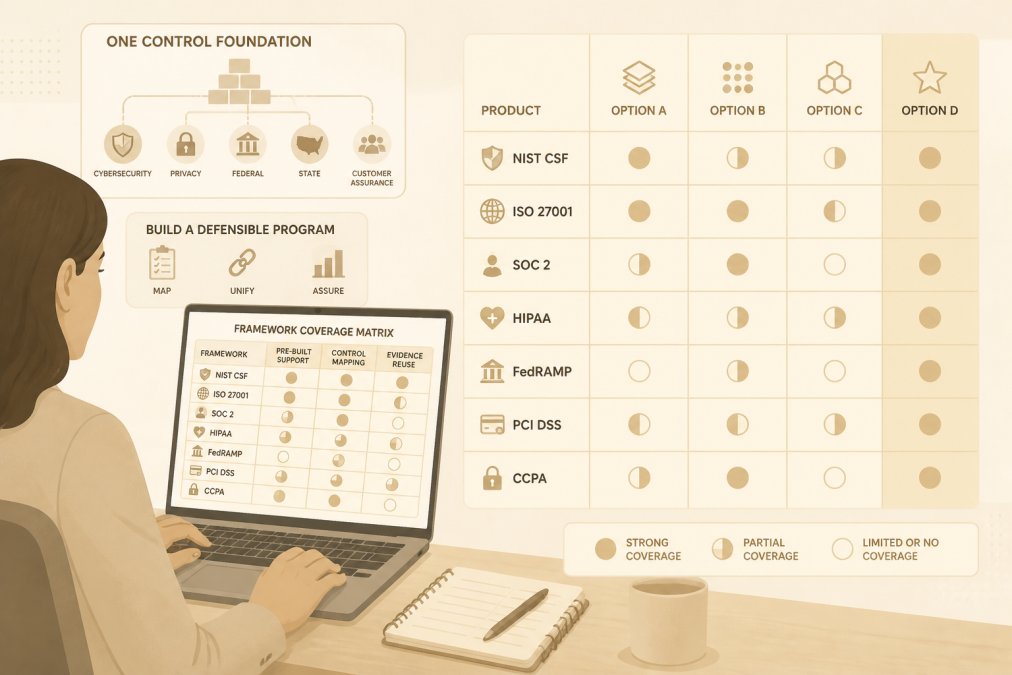
Framework coverage is where most comparisons stay vague. A side-by-side matrix forces specificity. For each platform, record:
- Pre-built frameworks: SOC 2, ISO 27001, HIPAA, FISMA, GDPR, CCPA/CPRA, and any state privacy laws that apply to you.
- Control library: Whether the platform uses a NIST-aligned master control catalog and maps frameworks to it, or treats each framework as a standalone project.
- Cross-framework reuse: Whether one piece of evidence can satisfy requirements in multiple frameworks without duplication.
- Update handling: How the vendor incorporates changes when a standard is revised.
A platform that maps frameworks to a shared control library shows overlap and uniqueness at a glance; one that doesn't forces parallel mappings, where contradictions and duplicated evidence creep in.
Team workflows: the criterion buyers underweight
Feature lists rarely capture how a tool feels in daily use. Compliance teams should evaluate workflows explicitly:
- Ownership and accountability: Can every control and evidence request be assigned to a named owner with a due date and status?
- Cross-functional contribution: Can IT and engineering staff submit evidence through a simple interface without full platform training?
- Audit collaboration: Can external auditors receive scoped access to review evidence without seeing the entire program?
- Executive reporting: Can leadership see posture at a glance while practitioners drill into control-level detail?
Other criteria worth scoring
- Continuous monitoring: Does the platform track evidence and control status in real time, or does compliance become a point-in-time audit exercise?
- Risk prioritization: Does it surface which risks matter to your business, or treat all findings equally?
- Integration capability: Can it pull data from existing security tools, or does it require manual data entry?
- Implementation burden: How much configuration is required before the first framework is usable?
Multi-Framework Compliance Software: Mapping Controls Across Standards
Multi-framework compliance software is the foundation of a defensible security program: map cybersecurity controls, regulations, risk, evidence, and remediation into one operating view so teams know what applies, where they stand, and what to do next.
When frameworks live in separate systems, control mappings conflict: one requires encryption, another authentication, a third both plus logging. Without unified mapping, teams build redundant controls or believe they've satisfied a requirement when they haven't.
The best multi-framework compliance software handles this by creating a master control catalog (typically NIST-aligned) and mapping all frameworks to it. This means:
- GDPR maps to specific NIST controls
- SOC 2 maps to the same controls
- ISO 27001 maps to overlapping controls
- State privacy laws map to relevant controls
- HIPAA and FISMA do the same
Teams then see exactly where frameworks overlap and where they require unique controls, eliminating redundant assessments and helping leaders prioritize which controls matter most.
Compliance automation becomes possible only after this foundational work is done. Automated workflows can then route evidence collection, track control status, and alert teams when gaps emerge.
Audit Readiness Software: Continuous Monitoring and Evidence Management
Audit readiness software transforms compliance from a seasonal crisis into a continuous state, changing how teams allocate resources and how executives view security posture.
Traditional approaches concentrate effort in the weeks before an assessment, as teams scramble to gather evidence and demonstrate controls are operating. This creates workload peaks and valleys and leaves visibility gaps between audits.
Continuous monitoring flips this model: evidence is collected as work happens and control status is tracked in real time. When an audit arrives, the evidence already exists, so teams discuss findings rather than hunt for documentation.
The best audit readiness software includes:
- Automated evidence collection from security tools and systems
- Control status dashboards showing real-time compliance posture
- Audit trail logging for regulatory requirements
- Workflow automation to route evidence requests and approvals
- Reporting templates for common audit frameworks
- Evidence versioning and change tracking
More importantly, they gain visibility into their actual security posture rather than a snapshot from audit week.
CyberStrong vs. Explore: Framework Coverage and Team Workflows
Comparing specific CyberSaint alternatives requires understanding how each platform handles framework coverage and team usability. CyberStrong and Explore each have distinct strengths; the comparison below focuses on which frameworks are supported out of the box, how controls map across them, and how roles collaborate day to day.
Framework coverage and control mapping
CyberStrong is built around enterprise-scale GRC management, supporting a broad catalog of security and privacy frameworks and emphasizing mapping controls to a shared foundation for reuse across assessments. Confirm which frameworks are pre-built versus configurable, and whether cross-framework reuse is native or custom.
Explore positions itself as a lighter-weight alternative for teams needing compliance without heavy configuration, trading narrower out-of-box framework coverage for faster onboarding. Verify whether the frameworks you need, SOC 2, ISO 27001, HIPAA, state privacy laws, are native or require add-on work.
A practical way to compare the two is a framework coverage matrix. For each framework your team manages, ask:
- Is the framework pre-built, or does it require custom configuration?
- Does the platform map framework requirements to a shared control library, or does each framework stand alone?
- Can evidence collected for one framework be reused for another without rework?
- How are framework updates handled when a standard changes?
Team workflows and usability
Framework coverage only matters if the people doing the work can use the platform. Compliance teams span compliance, security, IT, and audit roles, each interacting with the tool differently.
CyberStrong leans toward configuration-heavy deployments, suiting organizations with dedicated GRC administrators, though smaller teams often report a steeper learning curve and longer time to value.
Explore emphasizes an intuitive interface and faster onboarding, though highly customized compliance environments may require additional configuration to match existing processes.
When comparing team workflows, ask how each platform handles:
- Ownership assignment: Can controls and evidence requests be assigned to specific people with clear due dates?
- Evidence collection: Can non-compliance staff (IT, engineering) submit evidence without full platform training?
- Audit collaboration: Can external auditors be given scoped access to review evidence without exposing the full program?
- Reporting: Can executives see posture at a glance while practitioners drill into control-level detail?
Where a unified approach fits
NorthStar Intelligence Portal combines enterprise-scale framework coverage with practitioner-focused workflows, mapping dozens of international privacy frameworks to a single NIST SP 800-53 control library built by practitioners who experienced this fragmentation firsthand.
The key differentiator is that NorthStar positions compliance as the natural result of a well-run security program rather than the goal itself. This shifts how teams prioritize remediation and allocate resources. For compliance teams, the practical test is whether the platform lets a security engineer, a compliance analyst, and an external auditor work from the same control and evidence record, without duplicating effort or maintaining parallel spreadsheets.
Migration and Implementation: Avoiding Vendor Lock-In
Moving from one GRC platform to another raises legitimate concerns about vendor lock-in and implementation burden: data portability, migration timelines, and whether switching actually improves your situation.
Vendor lock-in risk is real when a platform stores your control mappings, evidence, and audit history in a proprietary format with no export capability. Before committing to any CyberSaint alternative, verify:
- Can you export your control library in a standard format?
- Can you export evidence and audit trails?
- Is your data stored in a way that survives platform migration?
- Does the vendor support data portability in their contracts?
Implementation timelines vary widely. A light-weight platform might take 4-8 weeks to deploy. An enterprise-scale system might require 3-6 months.
The best CyberSaint alternatives minimize implementation burden by providing pre-built framework mappings rather than requiring teams to build them from scratch. This reduces timeline and cost while improving quality.
One often-overlooked factor is training and change management: a platform that's easy to implement but requires significant process changes can stall adoption. Look for vendors providing hands-on implementation support and training for your team structure.
Making the Right Choice for Your Compliance Program
Selecting the right CyberSaint alternative requires clarity about what your compliance program actually needs. Generic feature comparisons miss the real decision drivers.
Start by mapping your current state. How many frameworks do you manage? Where do your teams spend the most time? What's your audit cycle?
Consider your implementation capacity. Some teams can absorb a complex platform with significant customization; others need faster time to value and simpler workflows.
Evaluate the vendor's approach to compliance philosophy.
Finally, talk to current customers in your industry and organization size.
The right CyberSaint alternative won't eliminate compliance work. But it should eliminate duplicate work, clarify priorities, and give your team clear visibility into your actual security posture.
Compliance programs built on fragmented tools waste time and create blind spots.
Frequently Asked Questions
What are the best alternatives to CyberSaint for compliance teams?
The best CyberSaint alternatives depend on your specific needs. Platforms like NorthStar Intelligence Portal excel at mapping multiple frameworks (GDPR, CCPA, SOC 2, ISO 27001) to a single control foundation, reducing duplicate work. Others focus on specific verticals or offer stronger workflow automation for stretched compliance teams. Evaluate based on framework coverage, ease of implementation, pricing transparency, and whether the platform treats privacy as integrated rather than bolted-on.
How does multi-framework compliance software reduce audit burden?
Multi-framework compliance software eliminates duplicate assessments by mapping overlapping requirements to shared controls. Instead of running separate audits for SOC 2, ISO 27001, and GDPR, teams maintain one control library and generate evidence once. This approach cuts assessment cycles, reduces false positives, and gives auditors a clear view of your security posture without starting from scratch each time.
What should compliance teams prioritize when comparing GRC platforms?
Prioritize: (1) Framework coverage matching your regulatory obligations, (2) Control mapping capability to avoid manual configuration, (3) Evidence management and continuous monitoring to reduce assessment friction, (4) Ease of implementation so you're not locked into a multi-year deployment, (5) Transparent pricing without per-framework or per-user surprises, and (6) Integration with existing security tools to avoid manual data entry.
Can GRC software actually map one control to multiple compliance frameworks?
Yes. Platforms built on NIST-aligned control libraries can map a single control to multiple frameworks. For example, access control requirements appear in HIPAA, SOC 2, ISO 27001, and GDPR, but they're the same underlying control. Purpose-built GRC software recognizes this overlap and lets you satisfy multiple requirements from one evidence artifact, eliminating redundant work and improving audit readiness.