
7 Steps to Build a Defensible Security Program for Tollways
Last Updated: November 1, 2026
Quick Summary
To build a defensible security program for tollways, start with a tollway cybersecurity risk assessment, then layer segmentation, identity controls, and legacy-system protection on one documented control foundation. Every requirement should map back to a known risk, a named owner, and stored evidence, so you can prove your posture to regulators, auditors, or a board without rebuilding the story each time.
- A defensible program ties every requirement to a known risk, a named owner, and stored evidence.
- Score each asset on impact and likelihood, ranking payment-handling revenue systems highest.
- Default-deny between the lane zone and corporate IT is the highest-value control in most tollway environments.
- Test firmware and configuration changes in a staging environment and schedule production changes in low-traffic windows.
- Practice incident response at least once a year and include lane operations staff, not just IT.
Table of Contents
- Why Tollway Security Programs Fail Without a Single Control Foundation
- Start With a Tollway Cybersecurity Risk Assessment
- Secure Transportation Operational Technology Security Across Roadside Systems
- Use a Cybersecurity Program Roadmap Template to Sequence the Work
- Build Defense in Depth: Segmentation, Identity, and Legacy-System Protection
- Write Incident Response and Continuity Playbooks for Tolling Operations
- Get Cybersecurity Audit Evidence Management Right the First Time
- Request a Demo and Map Your First Framework to One Control Catalog
- Frequently Asked Questions
Why Tollway Security Programs Fail Without a Single Control Foundation
Most teams that try to build a defensible security program for tollways fail for one reason: they are built as a pile of separate projects.
The fix is one control foundation every requirement maps back to.
Tollways make this harder than most environments.
So how do you build a defensible security program for tollways that holds up? Below, we walk through seven steps, from the first risk assessment to a single control catalog.
Start With a Tollway Cybersecurity Risk Assessment
A tollway cybersecurity risk assessment names your assets, the threats that target them, and the gaps between what you have and what you need.
Start with an asset inventory. List every system that matters:
- Toll collection and back-office revenue systems
- Plate management and violations processing
- Roadside gantries, sensors, and cameras
Then score each asset on impact and likelihood. A revenue system that handles payments ranks higher than an internal reporting tool.
The NIST Cybersecurity Framework gives you a tested structure for this work.
Once you have findings, turn them into a control baseline.
Secure Transportation Operational Technology Security Across Roadside Systems
Transportation operational technology security covers the systems that run the road itself: gantries, sensors, controllers, and the networks connecting them.
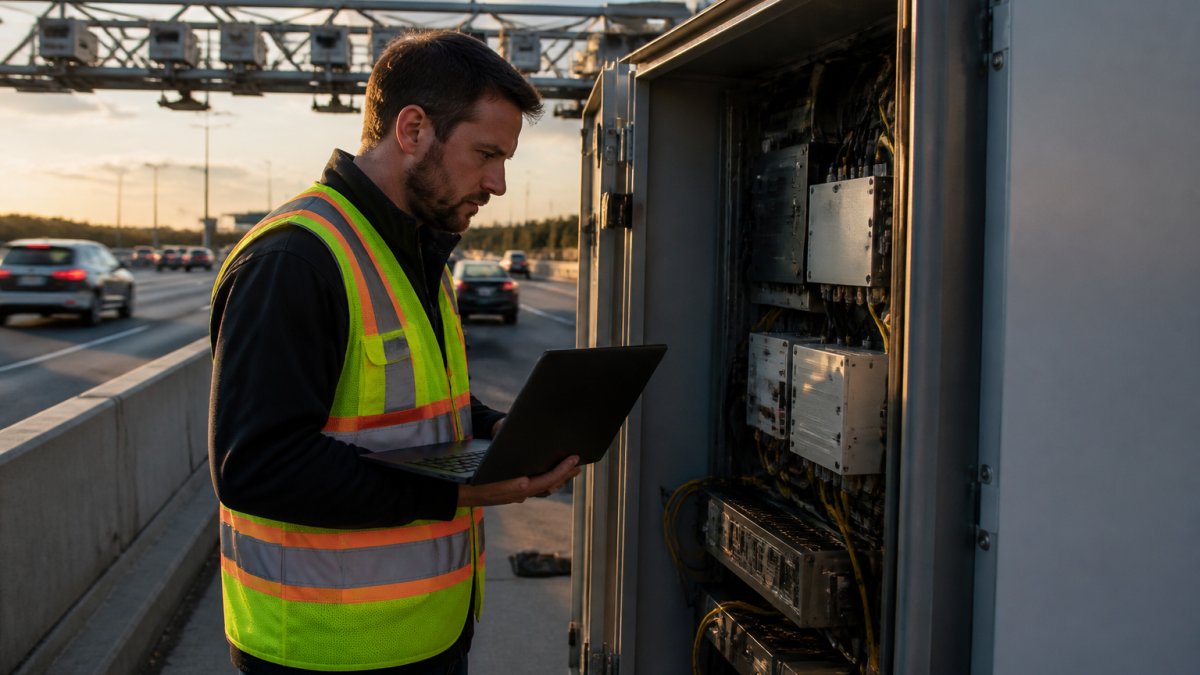
Operational technology (OT) has different rules than information technology (IT). You cannot just patch a gantry controller on a Tuesday afternoon and hope nothing breaks. Uptime comes first.
Inventory the tollway OT estate before you defend it
Most tollway operators find their OT inventory is incomplete the first time they try to segment it. Build the list by physical location, not by spreadsheet convenience:
- Lane and plaza equipment: toll collection terminals, automatic vehicle classification sensors, weigh-in-motion pads, lane controllers, and barrier gates.
- Roadside gantries: cameras, radio-frequency readers, transponders, and the edge compute cabinets that aggregate them.
- Communications: fiber and wireless links between plazas, gantries, and the back office, plus the switches and routers that terminate them.
Tag each asset with owner, location, firmware version, patch source, and whether it can be taken offline without closing a lane. That last field drives later decisions.
Segment in zones, then control the conduits
A workable tollway architecture uses zones and conduits rather than a flat roadside network:
- Lane zone: controllers and sensors at a single plaza or gantry, reachable only from a local aggregation point.
- Roadside aggregation zone: edge cabinets that collect lane data and forward it over a single controlled conduit.
- Tolling back-office zone: plate management, violations, and revenue systems, separated from corporate IT.
Traffic between zones should pass through a monitored gateway or firewall with an explicit allowlist. Default-deny between the lane zone and corporate IT is the highest-value control in most tollway environments, stopping a phishing compromise in the office from reaching a gantry controller.
Protect legacy controllers you cannot replace
Many tollway operators run lane controllers and gantry equipment that no longer receives vendor patches. Replacement cycles are long and capital-intensive, so protection has to come from the architecture around the device:
- Isolate legacy devices on their own segment with a monitored gateway in front.
- Restrict access to a small, named group and log every session.
- Disable unused services and ports where the vendor permits.
Test patches and changes before they touch live lanes
OT change management is where tollway programs most often slip. A patch that reboots a controller mid-rush can close lanes. Build a lab or staging environment that mirrors your lane configuration, test firmware and configuration changes there first, and schedule production changes in low-traffic windows.
The Cybersecurity and Infrastructure Security Agency publishes guidance on protecting critical infrastructure and on OT/ICS security that applies directly to roadside systems.
Use a Cybersecurity Program Roadmap Template to Sequence the Work
A cybersecurity program roadmap template is a phased plan that orders your security work by risk, cost, and dependency. It answers the question every leader asks: what do we do first?
Without a roadmap, teams chase whatever audit is closest. With one, you fix the biggest risks first.
A simple roadmap structure works well:
| Phase | Focus | Typical Timeframe |
|---|---|---|
| Phase 1 | Asset inventory and risk assessment | First quarter |
| Phase 2 | Network segmentation and access control | Second quarter |
| Phase 3 | Incident response and evidence capture | Third quarter |
| Phase 4 | Maturity targets and continuous reporting | Fourth quarter |
Adjust timing to your size and budget, the order matters more than the dates. When your roadmap spans several frameworks, this guide to mapping multiple compliance frameworks shows how to sequence them together.
Build Defense in Depth: Segmentation, Identity, and Legacy-System Protection
Defense in depth means stacking security layers so that one failure does not open the whole system.
Segmentation keeps a breach contained: if an attacker gets into the corporate network, they should not reach toll collection systems.
Identity management is the next layer. Every person and every system needs a known identity with the least access required.
Legacy systems need special handling. Many tollway operators run equipment that no longer receives vendor patches, so you protect it:
- Isolate legacy systems on their own network segment
- Put a monitored gateway in front of them
- Limit access to a small, named group
The Secure Controls Framework helps organize the controls behind these layers so they stay consistent. Our Secure Controls Framework guide explains how to map them.
Write Incident Response and Continuity Playbooks for Tolling Operations
An incident response playbook is a written plan telling your team what to do when something goes wrong. For tolling operations it must cover both cyber and physical disruption, and answer a question most generic playbooks ignore: how do we keep traffic moving and revenue accounted for while we recover?
When a gantry goes down, the clock starts: every minute costs revenue and creates traffic problems. Your playbook should name who does what, in what order, and what the operator does at the lane while the back office is unavailable.
Build playbooks around tollway failure modes
Write a separate playbook for each failure mode you can realistically face, and keep each one short enough to use under pressure:
- Ransomware on a back-office revenue system: isolate the affected segment, switch to a documented manual or degraded collection mode, preserve forensic evidence, and notify leadership and counsel.
- Loss of network link to roadside equipment: confirm whether the lane can buffer transactions locally, define how long buffering is safe, and set the threshold for manual collection.
- Suspected tampering with a toll controller or reader: stop trusting that device's data, preserve logs, dispatch a physical inspection, and decide whether to close the lane.
Define continuity mechanics, not just notifications
Continuity for a tollway is about keeping the road open and the revenue trail intact. Spell out the mechanics in advance:
- Degraded collection modes: document how a lane operates when the back office is unreachable, including local buffering limits and the manual fallback procedure.
- Revenue reconciliation: define how transactions collected during an outage are reconciled afterward so the audit trail survives.
- Customer communications: prepare holding statements for channels handling violations and account questions.
Name roles, contacts, and decision rights
Each playbook needs a named incident commander, lane-operations lead, communications lead, and liaison for law enforcement and emergency management, with after-hours contacts and a clear escalation path. Decide in advance who can close a lane or switch to manual collection, that decision should not be improvised at 2 a.m.
Exercise the plan against realistic scenarios
Practice at least once a year, and include lane operations staff, not just IT. Run a tabletop that combines a cyber incident with a physical disruption, because real events rarely stay in one category.
The Federal Highway Administration has adopted a voluntary cybersecurity evaluation tool to help transportation authorities prepare for and recover from cyber threats. Use it to stress-test your playbooks, then map the resulting procedures back to your control catalog so incident response is provable, not just documented.
Get Cybersecurity Audit Evidence Management Right the First Time
Cybersecurity audit evidence management is the practice of collecting and storing proof that your controls work, so audits and assessments do not turn into fire drills.
The mistake teams make is gathering evidence only when an auditor asks.
Build evidence capture into daily work:
- Store control evidence in one place, tied to the control it proves
- Set a review date for each piece of evidence
- Reuse evidence across frameworks
- Keep an audit trail of who changed what and when
This is where a single control foundation pays off. The NIST Cybersecurity Framework implementation guide gives you the assessment and evidence structure auditors expect.
Request a Demo and Map Your First Framework to One Control Catalog
The hardest part of building a defensible security program for tollways is not knowing what to do.
That is the problem NorthStar Intelligence Portal was built to solve.
The platform connects requirements, controls, risk, remediation, evidence, and reporting into one operating view, so compliance becomes the natural result of a well-run program.
Ready to map your first framework to one control catalog?
Tollway security will not get simpler: threats grow, regulators add requirements, and legacy systems stay in service longer than planned.
Frequently Asked Questions
How do you build a defensible cybersecurity program for a tollway?
Start from a single control catalog rather than a stack of separate framework projects. Inventory every tollway asset, including lane controllers, plate cameras, back-office billing, and payment systems, then run a tollway cybersecurity risk assessment that ranks threats by operational impact. Map the resulting controls to NIST SP 800-53, assign owners, and sequence remediation through a written roadmap. Keep evidence tied to each control as you go, so audits and customer assurance questionnaires pull from the same source instead of triggering new data calls.
Which NIST framework should a tollway operator use?
NIST SP 800-53 is the practical anchor for a tollway program because it gives you a control-level library detailed enough to satisfy federal, state, and customer requirements at once. Use the NIST Cybersecurity Framework to organize the program into identify, protect, detect, respond, and recover functions for executive reporting. The FHWA has also adopted a voluntary cybersecurity evaluation tool built around those same functions, which makes it a useful self-assessment companion. Mapping both onto one control catalog avoids running two parallel programs.
How should tollway operators assess cybersecurity risks to tolling systems?
Begin with an asset inventory that separates information technology from operational technology, since lane and roadside equipment carries different failure modes than back-office systems. For each asset, document the threat, the likelihood, and the operational consequence, such as a lane outage, plate-read violations going unbilled, or a payment data breach. Rate each risk and record the treatment decision. Repeat the assessment at least annually and whenever you add a vendor, a lane, or a payment channel.
What evidence should a tollway cybersecurity program retain?
Retain evidence that proves each control operated, not just that a policy exists. That means access reviews with sign-off dates, configuration baselines for lane controllers, patch records, vulnerability scan results, incident tickets with resolution notes, and vendor security assessments. Store it against the control it satisfies so a single artifact can answer multiple framework questions. Centralized cybersecurity audit evidence management cuts the scramble before audits and keeps customer questionnaires from turning into separate projects.
